
Identify a Shunt Valve by X-ray
Shunts · X-ray identification
What is this valve — and how do I read its setting?
Start with the overall shape and what is metallic. Then use the valve-specific cue to read the setting. Click any image to enlarge. Every image is openly licensed (CC BY 4.0) and credited; where no open image exists, the manufacturer's own X-ray guide is linked.
First-look sorting
Round titanium disc with a rotor or dial
Miethke adjustable valves — proGAV / proGAV 2.0 (four rotor magnets in pairs), M.blue (rim of coding holes with a triangular pointer), proSA.
Miethke adjustable valves — proGAV / proGAV 2.0 (four rotor magnets in pairs), M.blue (rim of coding holes with a triangular pointer), proSA.
Two square magnets in a faint round body + arrow connectors
Sophysa — Polaris (5 positions, magnetic lock) or Sophy SM8 (8 positions). Radiopaque dots left of the inlet give the pressure range.
Sophysa — Polaris (5 positions, magnetic lock) or Sophy SM8 (8 positions). Radiopaque dots left of the inlet give the pressure range.
Small ring (cam) with a dot
Codman HAKIM programmable — read the marker against the right-hand-side marker; 70 / 120 / 170 sit on the central cross.
Codman HAKIM programmable — read the marker against the right-hand-side marker; 70 / 120 / 170 sit on the central cross.
Short bright bars around a small rotor
Codman CERTAS Plus — the setting is the sector holding the magnet with the tantalum ball.
Codman CERTAS Plus — the setting is the sector holding the magnet with the tantalum ball.
A single dense magnet, valve body barely visible
Medtronic Strata family (Strata II / NSC); StrataMR II adds an extra tantalum marker.
Medtronic Strata family (Strata II / NSC); StrataMR II adds an extra tantalum marker.
Almost nothing — only arrows or dots
Non-metallic Medtronic Delta or PS Medical CSF-Flow Control valve: read the radiopaque arrow / dot code.
Non-metallic Medtronic Delta or PS Medical CSF-Flow Control valve: read the radiopaque arrow / dot code.
Gallery
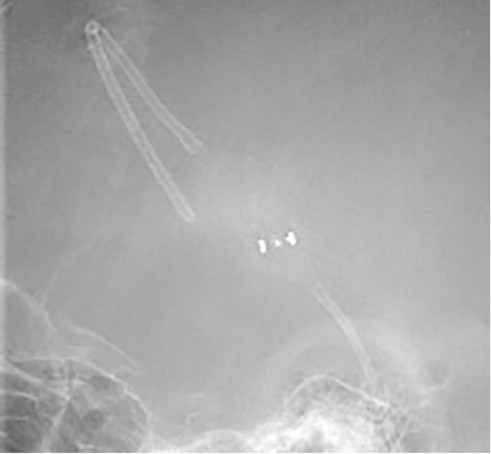 CERTAS Plus
Integra (Codman) · Current
- Elongated valve; bright rectangular magnets on a central rotating construct.
- Setting = the overlay sector holding the magnet that has the tantalum ball beside it; a right-hand-side (RHS) marker orients the film.
- Read with the Integra X-ray overlay tool aligned to the valve centerline and connectors.
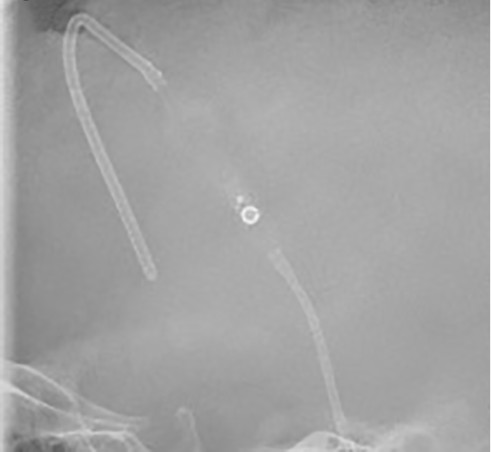 Hakim Programmable (CHPV)
Integra (Codman) · Current
- Small ring (cam) with an adjacent white dot — the radiopaque marker on the cam.
- Read the marker position against the fixed right-hand-side marker; settings 70, 120 and 170 sit on the central cross.
- Inverted valve: the white marker appears on the LEFT. Program 210 − desired (190/200 not reachable) after first setting 200.
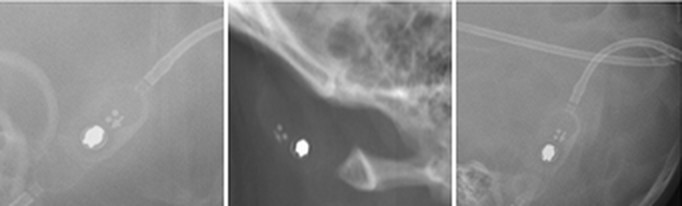 Strata II (with Delta chamber)
Medtronic (PS Medical) · Legacy (widely implanted)
- Bright, slightly irregular dense magnet inside a faint (mostly non-metallic) valve body.
- Performance level can be confirmed by X-ray, though Medtronic designed the hand tools to verify without one.
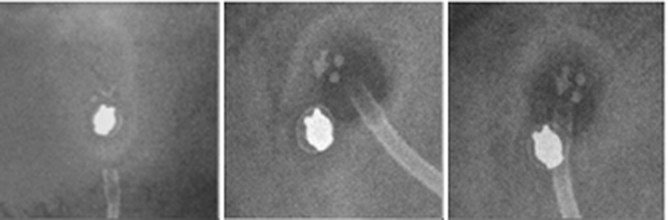 Strata NSC (no siphon control)
Medtronic (PS Medical) · Legacy (widely implanted)
- Dense magnet inside a faint valve body — radiographically similar to Strata II (the source dataset grouped them as 'Strata II – NSC').
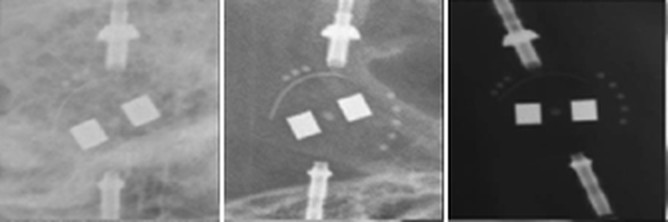 Polaris (SPV)
Sophysa · Current
- Two square magnets in a round, mostly radiolucent body; arrow-shaped connectors show flow direction.
- Titanium studs on the right side mark the 5 rotor positions; radiopaque range dots left of the inlet: 0 = 10–140, 1 = 30–200, 2 = 50–300, 3 = 80–400.
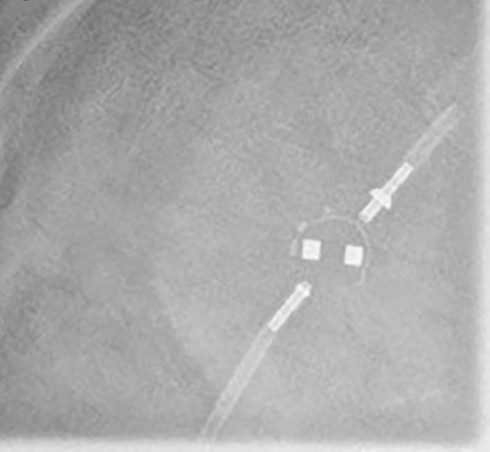 Sophy Mini SM8
Sophysa · Current
- Two square magnets inside a faint round outline; arrow-shaped connectors.
- Radiopaque dots read the 8 positions directly; range dots left of the inlet (0–3) identify the range.
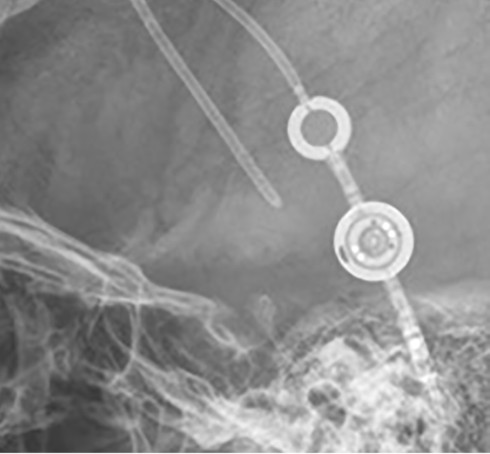 proGAV 2.0
Miethke · Current
- Round titanium valve; four rotor magnets show as white dots in opposite pairs.
- Two black burr holes mark the rotor's rear; the gap between the two front magnets (triangle apex) points to the setting.
- A side recess marks orientation so the scale is not read mirror-image; the gravitational unit carries a coded pressure marking.
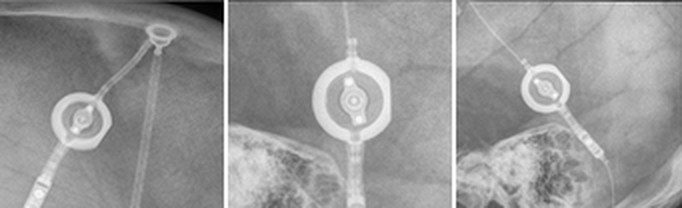 proGAV (1st generation)
Miethke · Legacy (superseded by proGAV 2.0)
- Round titanium valve with a central rotor; the rotor position is read against the scale (0–20 cmH2O).
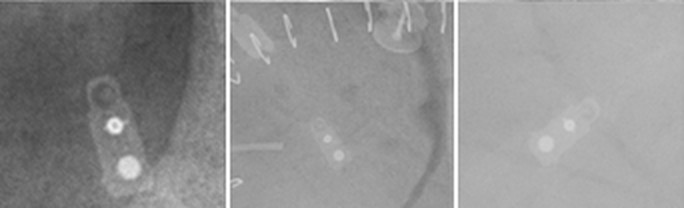 Hakim Precision (fixed)
Integra (Codman) · Current
- Small metallic ball-in-cone housing; no adjustable cam or rotor.
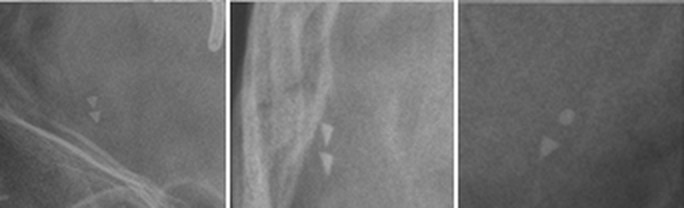 Delta valve
Medtronic (PS Medical) · Current
- Valve body is essentially radiolucent — look for the radiopaque arrow/dot code: PL 0.5 = bar + arrow, 1.0 = single arrow, 1.5 = dot + arrow, 2.0 = double arrow.
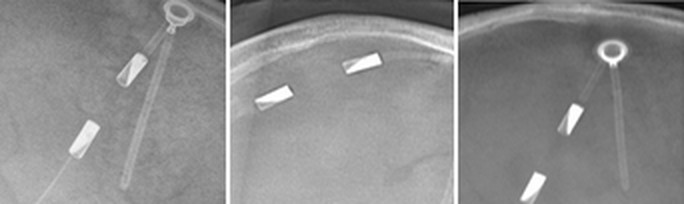 Integra DP
Integra · Legacy (many SKUs no longer in US distribution)
- Two small metallic in-line housings (the paired ball-in-cone mechanisms).
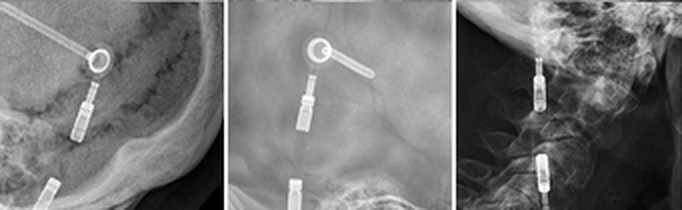 Spitz-Holter
Holter (later Integra) · Historic
- Cylindrical in-line valve with metal end segments, often just below a burr-hole reservoir ring.
Valves without an openly licensed radiograph (yet)
These valves are described from the manufacturer's radiographic guidance; the link opens the manufacturer's own X-ray illustration.
| Valve | X-ray features | Manufacturer X-ray guide |
|---|---|---|
| StrataMR II Medtronic |
|
Open ↗ |
| Sophy SM3 Sophysa |
|
— |
| M.blue Miethke |
|
Open ↗ |
| M.blue plus Miethke |
|
Open ↗ |
| proSA Miethke |
|
Open ↗ |
| CSF-Flow Control (PS Medical) Medtronic (PS Medical) |
|
Open ↗ |
| Sophy Mini SM1 Sophysa |
|
Open ↗ |
| GAV 2.0 Miethke |
|
Open ↗ |
| GAV (classic) Miethke |
|
Open ↗ |
| paediGAV Miethke |
|
Open ↗ |
| DualSwitch Valve (DSV) Miethke |
|
Open ↗ |
| miniNAV Miethke |
|
Open ↗ |
| SHUNTASSISTANT 2.0 (SA 2.0) Miethke |
|
Open ↗ |
| SHUNTASSISTANT / paediSHUNTASSISTANT Miethke |
|
Open ↗ |
| SiphonX Sophysa |
|
Open ↗ |
| SiphonGuard Integra (Codman) |
|
— |
| Gravity Compensating Accessory Integra |
|
— |
| OSV II (flow-regulating) Integra |
|
— |
| M.flow Miethke |
|
— |
Film technique
- Shoot perpendicular to the valve, with the non-implanted side of the head on the plate; position the film relative to the valve, not the patient's anatomy (Integra Hakim guide).
- Check orientation markers before reading a dial — a mirror-image read gives the wrong setting (Hakim right-hand-side marker; Miethke valve-marking recess; Sophysa range dots left of the inlet).
- Get a baseline film after implantation. After every MRI, confirm the setting of MRI-sensitive valves — Codman HAKIM (X-ray or programmer), Strata / Strata NSC (Medtronic tools or X-ray) and Sophy SM8 (adjustment kit or X-ray).
- Compare with the patient's own baseline films — an unknown outside valve should be identified before anyone tries to adjust it.